
A garage floor often takes more abuse than any other surface in the home. It holds vehicles, lawn equipment, tools, road salt, oil drips, muddy shoes, and heavy storage. The right garage flooring installation options can turn stained or dusty concrete into a cleaner, more useful space that is easier to maintain year after year.
The best choice depends on how you use the garage, the condition of the existing slab, your budget, and how quickly you need the space back in service. A homeowner parking two daily drivers has different needs than someone creating a workshop, home gym, hobby area, or finished extension of the house.
Start With the Condition of Your Concrete
A new finish is only as dependable as the concrete below it. Before choosing a coating, tile, or overlay, inspect the slab for cracks, peeling paint, moisture issues, uneven areas, and signs of surface deterioration. Minor hairline cracks can often be repaired as part of preparation. Larger cracks, settlement, or areas where the concrete is crumbling may need more extensive concrete work first.
Moisture deserves special attention in North Carolina garages. Ground moisture can move through a concrete slab, particularly in older homes or garages with limited drainage around the foundation. If a coating is installed over a damp slab without proper testing and preparation, it may bubble, peel, or lose adhesion. Professional installers evaluate the surface and recommend a system that fits its condition rather than applying a one-size-fits-all solution.
Garage Flooring Installation Options to Consider
Epoxy floor coatings
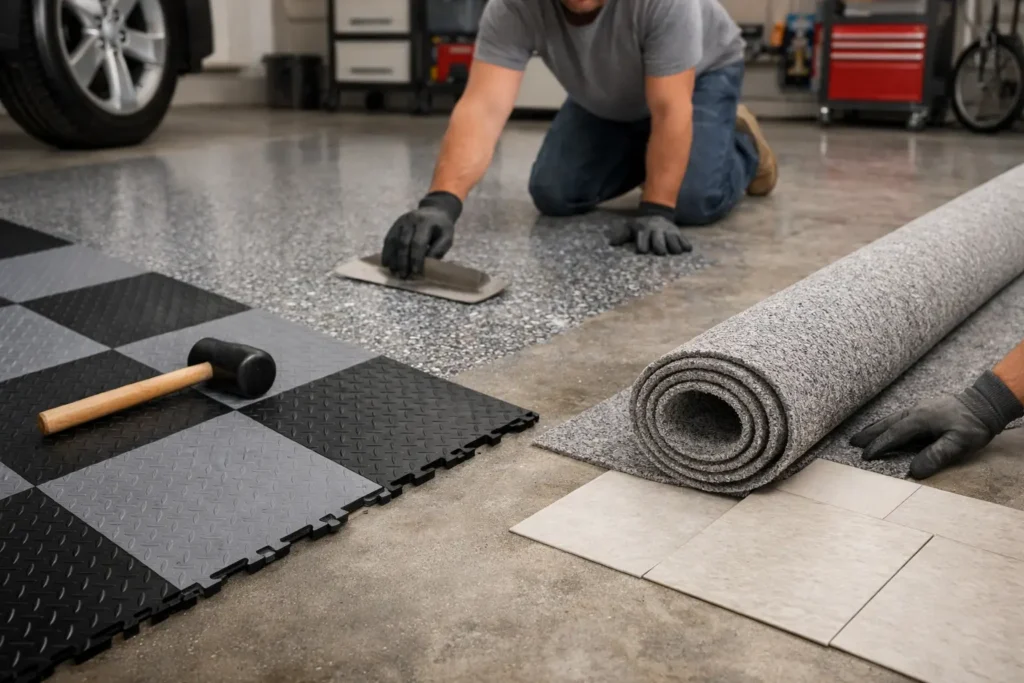
Epoxy is a familiar choice for homeowners who want a hard, finished surface with strong resistance to oil, chemicals, stains, and everyday garage traffic. It is applied as a liquid coating over prepared concrete and can be finished in solid colors or with decorative flakes that help disguise dirt and add texture.
A properly installed epoxy floor can make a garage feel brighter and more organized. It is especially practical for homeowners who use the space for vehicle maintenance, storage, or light workshop projects. Cleanup is straightforward because spills stay on the surface instead of soaking into porous concrete.
The trade-off is preparation and curing time. The concrete typically needs mechanical grinding or another approved profile method so the epoxy can bond correctly. Temperature and humidity also affect installation. Epoxy may not be the best fit when a fast return to service is the top priority, or where significant moisture is present without a suitable moisture-control system.
Polyaspartic and polyurea coatings
Polyaspartic and polyurea systems are advanced coating options often chosen for their faster cure times and durability. Like epoxy, they are installed over prepared concrete and can include decorative flakes and a protective topcoat. Many systems offer excellent resistance to abrasion, chemicals, and staining, making them a strong choice for active garages.
Their biggest advantage is scheduling. Some systems can be installed and returned to light use much sooner than traditional epoxy, depending on product specifications and site conditions. They also tend to perform well through changing temperatures, which matters in garages that are not fully climate controlled.
These coatings generally cost more than a basic epoxy application, and the installation window can move quickly. That makes experienced surface preparation and application especially important. Homeowners should also ask what the quoted system includes, such as crack repair, moisture testing, flake coverage, and topcoat protection.
Interlocking garage floor tiles
Interlocking tiles create a finished floor without coating the concrete directly. They are available in rigid plastic, flexible PVC, and various patterns that allow homeowners to create borders, parking pads, or color zones for work areas and storage.
Tiles can be a sensible option for a garage where access to the slab may be needed later. Individual pieces can often be lifted and replaced if one becomes damaged. Their raised or channel-style designs can also allow moisture to move beneath the surface instead of sitting where vehicles park.
However, not every tile system performs the same way under heavy loads. Thin tiles can shift, separate, or show wear in high-traffic areas, especially beneath turning tires. Dirt and moisture can also collect below tiles, so occasional lifting and cleaning may be necessary. For a garage that is routinely wet or used for messy mechanical work, a seamless coating may be easier to keep clean.
Roll-out mats and floor runners
Roll-out vinyl mats and parking pads are among the quickest garage flooring solutions. They protect concrete from tire marks, water, salt, and small spills, and they require very little installation beyond measuring, cutting, and positioning the material.
This option works well for homeowners who want immediate protection without committing to a permanent finish. A mat can be useful under a parked vehicle, at a workbench, or in a small garage where only part of the floor needs coverage. It is also a practical temporary solution while planning a larger renovation.
Mats do have limits. Water can become trapped beneath them, edges can curl, and they may shift if the floor is uneven. They do not repair damaged concrete or provide the polished look of a professionally coated floor. Consider them a protective layer, not a structural improvement.
Concrete sealers and densifiers
For homeowners who prefer the natural appearance of concrete, a penetrating sealer or densifier can reduce dusting and make the surface less absorbent. These products do not create the thick, decorative film associated with epoxy or polyaspartic coatings. Instead, they strengthen or protect the existing concrete while maintaining a more understated finish.
This approach can be a good fit for garages with sound concrete that serve primarily as storage or utility space. It is typically lower cost than a full coating system and can improve routine cleanup. Still, it offers less stain protection and visual transformation than a coated floor. Deep oil stains, patchwork repairs, and existing discoloration will remain visible.
Polished concrete and decorative overlays
Polished concrete gives a garage a refined, low-maintenance look by mechanically grinding and finishing the existing slab. Decorative overlays can refresh worn concrete, correct certain surface imperfections, or create a more uniform appearance before a final finish is applied.
These options can be attractive in garages that double as studios, entertaining areas, home gyms, or enclosed workshops. They require careful assessment because the existing concrete determines what is possible. A heavily damaged or uneven slab may need repairs before polishing, while an overlay may not be appropriate where movement or moisture problems have not been addressed.
Match the Floor to How You Use the Space
A coating system is often the strongest all-around choice for a daily-use garage because it provides a continuous, easy-to-clean surface. For a workshop with welding, fabrication, or frequent heavy tool movement, durability and chemical resistance should take priority over appearance alone. If the garage is primarily storage and occasional parking, a quality sealer, tiles, or mats may offer enough protection at a lower initial cost.
Slip resistance should also be part of the conversation. Smooth glossy finishes can look sharp, but they may become slippery when wet. Decorative flakes, textured additives, and the right topcoat can improve traction without making cleaning difficult. The goal is not simply a floor that photographs well, but one that works safely for your household.
What Professional Installation Should Include
The difference between a long-lasting garage floor and an early failure often comes down to preparation. A professional quote should explain how the concrete will be cleaned, repaired, profiled, and tested before the finish is applied. It should also clarify expected curing time, the type of topcoat, and what level of traffic the completed floor is designed to handle.
Be cautious of projects priced only by square footage with no discussion of slab condition. A garage with old paint, oil contamination, moisture vapor, or failing concrete needs a different installation plan than a clean, newer slab. Clear expectations at the estimate stage help prevent surprises after work begins.
For homeowners planning garage upgrades in Greensboro, Winston-Salem, High Point, or surrounding communities, Carolina Improvements can assess the floor as part of a broader garage, concrete, or home improvement project. A coordinated plan can be especially helpful when flooring work is paired with driveway repairs, garage additions, storage improvements, or new doors.
A garage floor should make daily life easier, not create another surface to worry about. Choose a finish that fits the way your family parks, works, stores, and lives, then give the concrete preparation the attention it deserves.